
Turkish, Greek warships 'collide' during standoff in eastern Mediterranean waters
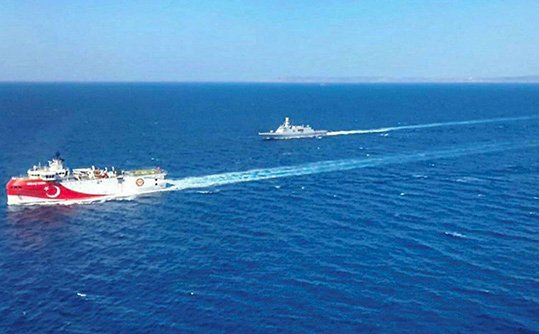
Turkey issued a Navtex international maritime safety message to say that it would be conducting exploratory drilling in the eastern Mediterranean. The Turkish research vessel Oruç Reis – accompanied by an escort of five navy ships – was then spotted in areas that both Turkey and Greece claim belong to their respective continental shelves.
Turkey has said it will conduct exploratory drilling between August 10 and 23.
In retaliation to the move, France and Greece said that they were conducting “joint military exercises”.
On Wednesday, news emerged of a “mini collision” following a stand-off in the eastern Mediterranean which was described as an “accident” involving the Turkish navy frigate TCG Kemal Reis (F-247) and the Greek frigate Limnos.
A defiant Turkish President Recep Tayyip Erdoğan, addressing an AK Party meeting this week, said: “Do not dare to attack our Oruç Reid [vessel]. If you do attack, you will pay the price dearly …”
Days earlier, President Erdoğan called on “all countries in the Mediterranean to come together to find a formula that protects the rights of everybody.
“We are prepared to find a resolution to the disagreements through dialogue,” he said, vowing that “no-one can ignore the rights of Turkey … no one can imprison us to our coast through islands that are just a few kilometres in size”.
Athens responded, calling on Turkey to “cease its illegal activity which is harming peace and security in the region”.
Turkish Foreign Ministry spokesman, Hami Aksoy, reacted to the words from the Greek capital, saying there was “no legal basis to object to our activities. The Mediterranean has been under the supremacy of Turks for centuries . . . it is no-one’s right to try and exclude us from the Mediterranean”.
Prime Minister Ersin Tatar called for an end to “the game being played by Greece and Egypt in the Mediterranean,” adding: “We stand in complete solidarity with Turkey over the steps aimed at protecting the rights of Turkish Cypriots.”
President Mustafa Akıncı, who has remained silent about the crisis, had previously called for “a joint commission” to be formed in Cyprus to handle hydrocarbon issues in the Eastern Mediterranean and to use it as a means of achieving “cooperation and not conflict”.
Deputy Prime Minister and Foreign Minister Kudret Özersay, who spoke to Turkish press this week, said: “The Eastern Mediterranean area is where the Republic of Turkey can breathe. Greece is acting with bad intentions and trying to achieve a fait accompli. We are obliged to show that we will most certainly not allow the side we are negotiating with [for a solution in Cyprus] to take advantage in the area.”
The EU’s foreign policy chief, Josep Borrell, described the mobilisation of naval forces as “extremely worrying”.
Meanwhile, political scientist Professor Dr Murat Özkaleli told Cyprus Today: “Maritime territorial disputes have once again turned the Eastern Mediterranean into a powder keg. As small skirmishes are being reported between the Turkish and the Greek navies, the situation could quickly escalate out of control. Both sides are playing chicken while brinkmanship has so far been the tactical choice. Nevertheless, the game in the Eastern Mediterranean is an infinite one, meaning that the purpose is to have the opposite side’s sources drained through continuing escalations, which is a very costly policy if not a totally unrealistic one.
“One should not forget that, according to the existing International Sea Law treaties and custom, until all states around the Eastern Mediterranean reach a multilateral agreement the bilateral agreements themselves cannot have much legal effect. Once again, political solution seems to be the right path to follow.
“War…hardly presents a resolution to ongoing territorial problems. One war usually sows the seeds of the next one. We need to go beyond episodic, short-term solutions.
“In summary, we need to seek ways that will bring peace to the Eastern Mediterranean.”
Related News

‘NO LAW AGAINST DIRECT FLIGHTS’
Jul 29, 2024
Tatar calls on UK voters to back IDS
Jul 1, 2024